| Leadership
in emergencies is a key because the effectiveness of
an emergency response is directly linked to the quality
of the emergency teams on the ground. While emergency
team performance is subject to a wide range of variables,
experience has shown that the success of an emergency
response team is inherently tied to the competence and
effectiveness of its leader.
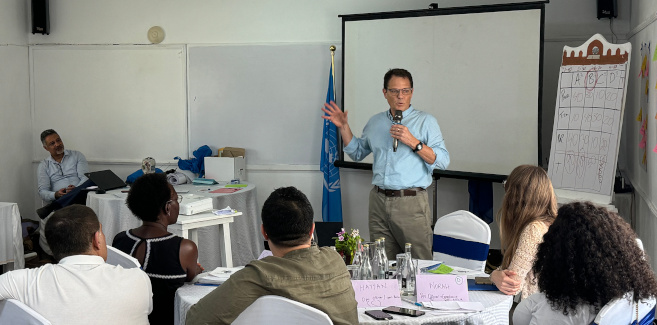
Participants in our training identify their strengths
and weaknesses as leaders and work on strengthening
their team leadership competencies (e.g. situational
leadership, teambuilding, direction setting, decision-making,
setting direction and communicating purpose, having
influence, practicing emotional intelligence, communication,
etc.).
Representative
Projects:
InterAgency Standing Committee (IASC),
2005-present:
For the IASC, comprised of UN and non-UN NGO humanitarian
partners, InterWorks has designed and is now facilitating
the Emergency Team Leadership Programme (ETLP).
The ETLP is a blended learning programme including
a pre-workshop distance learning component, a
face-to-face training workshop and a post-workshop
action learning activity. The overall objective
of the ETLP is to provide emergency staff leaders
with comprehensive training to strengthen the
quality of leadership in humanitarian operations,
support stronger coordination between agencies,
and foster the development of best practice in
emergency leadership and management.
United Nations Office of Coordination
of Humanitarian Assistance (OCHA), 2004-present:
InterWorks has been the lead facilitator at the
Emergency Field Coordination Training for the
workshop sessions dealing with leadership, meeting
management, teamwork, negotiation, influence,
and communication. |
|